 inquiry@findyourcar.me
 +971 58 510 1097




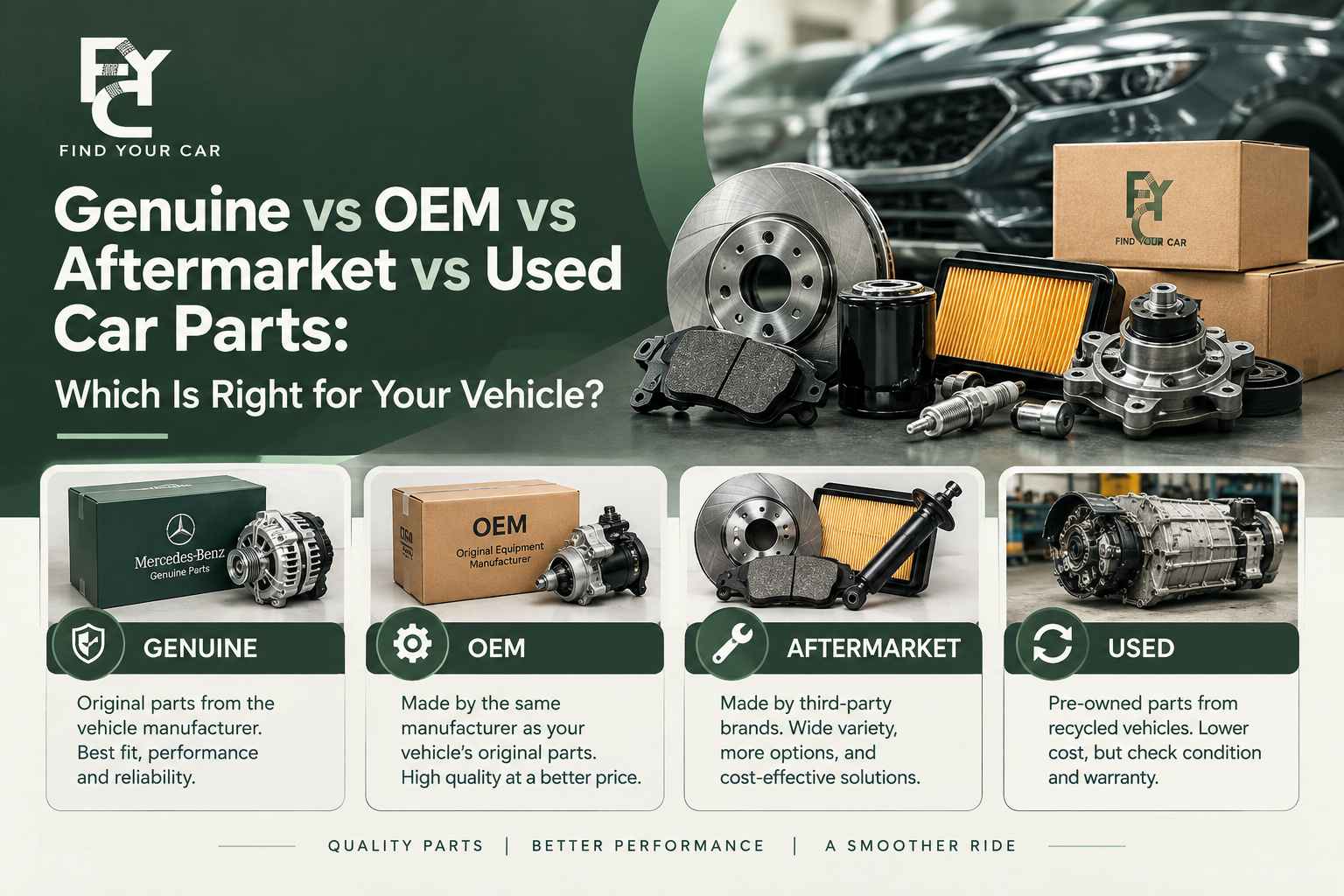
When you need to replace a car part, one of the first questions is: Should I buy a genuine, OEM, aftermarket or used part?
The answer isn’t always as simple as choosing the most expensive option.
Different vehicles, components, budgets and repair requirements can call for different solutions. A genuine component may be the preferred choice for one application, while a quality OEM or aftermarket part may offer better value for another. Used or reconditioned parts can also make sense for certain older vehicles or major assemblies.
At Find Your Car, we help customers compare available sourcing options based on vehicle compatibility, quality, availability, budget and urgency rather than simply recommending the most expensive part.
What Is a Genuine Car Part?
A genuine car part is sold under the vehicle manufacturer’s brand and is intended for the specific vehicle application.
Genuine parts can be particularly appropriate when:
- Exact manufacturer specification is important
- The vehicle is relatively new
- The component is safety-critical
- The customer specifically wants manufacturer-branded parts
- Warranty or manufacturer requirements are relevant
However, genuine parts can also carry a higher price.
What Is an OEM Car Part?
OEM stands for Original Equipment Manufacturer.
In automotive discussions, the term is often used for components produced by companies that manufacture parts for vehicle manufacturers or to original-equipment specifications.
The important point is that “OEM” should not automatically be treated as a universal quality guarantee. Buyers should still check the manufacturer, part number, specification and fitment.
For many repairs, a properly matched OEM component can provide a strong balance between quality and cost.
What Are Aftermarket Car Parts?
Aftermarket parts are manufactured by companies outside the vehicle manufacturer’s branded parts network.
The quality of aftermarket parts can vary significantly between manufacturers.
A quality aftermarket part can be a practical option when:
- The vehicle is older
- The part is a routine maintenance item
- The genuine part is expensive
- The original part is difficult to obtain
- A reliable aftermarket manufacturer is available
- The customer wants to control repair costs
What Are Used & Reconditioned Car Parts?
Used and reconditioned parts are another option, particularly when a new component is expensive or difficult to source.
Used parts may be suitable for certain:
- Body panels
- Headlights
- Mirrors
- Engines
- Gearboxes
- Suspension assemblies
- Electronic modules
- Interior components
Reconditioned components have been restored or refurbished before being supplied.
This option can be useful for older vehicles, accident repairs and major mechanical components where replacing the entire assembly with a new genuine unit may be unnecessarily expensive.
Genuine vs OEM vs Aftermarket vs Used: Quick Comparison
Genuine: Usually the highest price; manufacturer-branded; ideal for applications where exact specification or manufacturer branding is important.
OEM: Medium to high price; produced by original equipment suppliers; often a strong quality/value option.
Aftermarket: Usually lower price; independent brands; useful for selected repairs when a reputable manufacturer and correct fitment are confirmed.
Used/Reconditioned: Usually lower price; condition varies; useful for older vehicles, difficult-to-source components and certain major assemblies.
Which Type of Car Part Should You Choose?
For Brakes, Steering & Safety-Critical Components
For safety-critical components, quality and compatibility should come before price.
Depending on the vehicle and application, genuine or reputable OEM-quality components may be preferable. Always verify the exact part specification before ordering.
For items such as filters, certain service components, belts, wipers and common wear parts, a reputable OEM or quality aftermarket option can provide a good balance between cost and performance.
Older vehicles can present a different challenge. A genuine part may be expensive or no longer readily available.
In these situations, OEM, reputable aftermarket, used or reconditioned parts may provide practical alternatives.
For Accident Repairs
Accident repairs can involve many components at once, including bumpers, headlights, fenders, doors, grilles, mirrors, body panels and mechanical components.
Depending on the vehicle’s age and repair budget, genuine, aftermarket or selected used components may all be worth considering. The important thing is to verify exact fitment before ordering.
For Engines and Gearboxes
Major assemblies require additional consideration. For used or reconditioned engines and gearboxes, buyers should ask about:
- Compatibility
- Engine/gearbox specification
- Condition
- Mileage where available
- Inspection/testing
- Warranty or applicable support
- Shipping requirements
Why VIN Matching Is More Important Than the Part Category
Choosing “genuine” or “OEM” doesn’t help if you receive the wrong component.
Vehicle variants can have different engine specifications, model years, chassis numbers, gearboxes, electrical systems and regional specifications.
That’s why FYC recommends using the VIN, chassis number or original part number when sourcing parts.
How to Choose the Right Part Based on Your Budget
Premium requirement — Consider Genuine
Best when manufacturer branding, exact specification or maximum assurance is the priority.
Quality + value — Consider OEM
A potential middle ground when you want strong quality without necessarily paying the full genuine-part price.
Cost-conscious repair — Consider Quality Aftermarket
Suitable for selected applications where a reputable manufacturer and correct fitment can be confirmed.
Older vehicle / difficult-to-source component — Consider Used or Reconditioned
Potentially useful when new parts are unavailable or economically impractical.
Don’t Choose a Car Part Based on Price Alone
The cheapest part isn’t always the cheapest repair. Consider the total cost, including:
- Purchase price
- Shipping
- Installation labour
- Vehicle downtime
- Risk of incorrect fitment
- Replacement cost if the part fails
- Availability of technical support
For an international order, getting the correct component the first time can be particularly important because returning or replacing a wrongly sourced part can take additional time and money.
Why Source Car Parts from Dubai?
Dubai provides access to a large automotive trading and logistics ecosystem. For international buyers, sourcing from Dubai can provide access to:
- Genuine parts
- OEM parts
- Aftermarket parts
- Used parts
- Reconditioned components
- European vehicle parts
- Japanese vehicle parts
- Export and freight services
FYC operates from Dubai and provides sourcing and export support to international and African markets.
Why Choose Find Your Car?
FYC takes a sourced-to-order approach, helping customers identify the right part before sourcing it. The process is:
1. Share Your Vehicle Details — Provide your VIN, chassis number, part number, vehicle model or photograph.
2. Identify & Verify the Part — The requirement is reviewed and the appropriate part and available options are identified.
3. Compare Your Options — Where available, compare genuine, OEM, aftermarket or used/reconditioned options.
4. Receive Your Quote — Receive pricing and availability before confirming the order.
5. Packing & Delivery — Once confirmed, the part is prepared and shipped according to the agreed requirements.
Frequently Asked Questions
Are genuine car parts better than aftermarket parts?
Not necessarily for every application. The right choice depends on the component, vehicle, manufacturer, application, budget and quality of the alternative.
Are OEM parts cheaper than genuine parts?
OEM parts can often provide a lower-cost alternative, but pricing depends on the specific part and supplier.
Are aftermarket car parts reliable?
Quality varies between manufacturers. A reputable aftermarket manufacturer and correct fitment are important.
Are used car parts worth buying?
They can be, particularly for older vehicles, major assemblies and difficult-to-source components, provided the part’s condition and compatibility are properly assessed.
Should I provide my VIN when buying car parts?
Yes. VIN-based identification can significantly reduce the risk of ordering the wrong component.
Can I source genuine, OEM and aftermarket parts from Dubai?
Yes. FYC sources these categories and also offers used and reconditioned options where suitable.


