 inquiry@findyourcar.me
 +971 58 510 1097




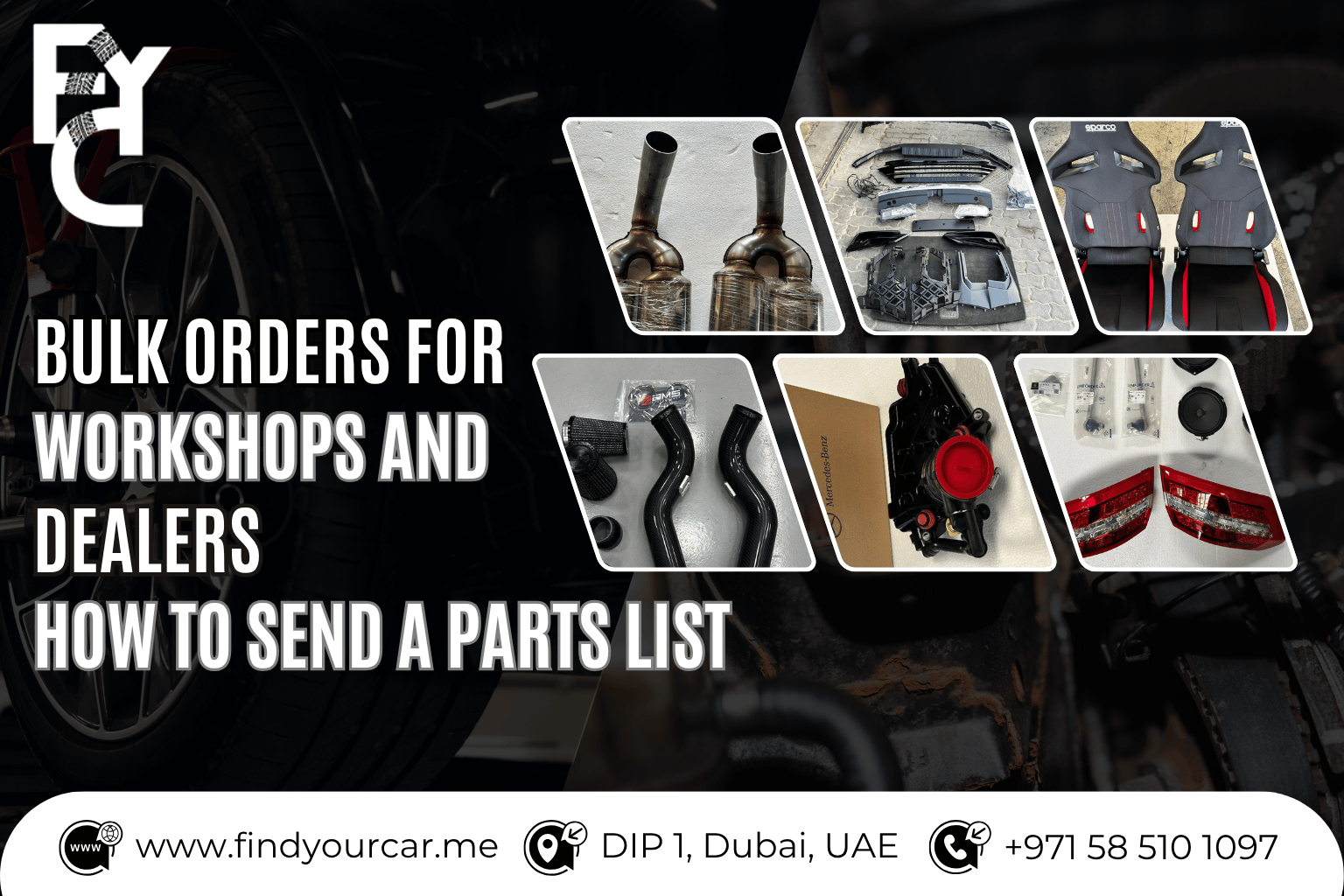
For workshops, dealerships and spare parts traders, a bulk order is only as good as the parts list behind it. One missing digit in an OEM number or a vague part description can lead to the wrong item, a delayed shipment or a costly return. This matters even more when the parts are crossing borders.
Dubai has long been a major sourcing hub for the region and for African buyers. Working with an experienced auto spare parts supplier in Dubai gives workshops in Nairobi, Dar es Salaam or Johannesburg access to a wide range of brands and part types through one point of contact. But the supplier can only quote accurately if the request is clear.
This guide explains how to prepare and send a bulk parts list, step by step, so your quotation and order run smoothly.
Why Proper Parts Lists Matter for Bulk Orders
A well-prepared list does more than save time. It directly affects the quality of the whole purchase.
- Fewer ordering mistakes: Clear part names, numbers and vehicle details reduce the risk of incompatible parts.
- More accurate quotations: Suppliers can only price what they can identify with confidence.
- Better purchasing efficiency: A structured list can be reused, updated and compared against previous orders.
- Smoother sourcing: When a supplier does not have to chase missing details, they can concentrate on checking availability and options.
Think of the parts list as the foundation of the transaction. Everything that follows, from quotation to packing, depends on it.
How to Prepare a Bulk Auto Parts List
Before you contact a supplier, gather the following information for each line item:
- Vehicle make and model: for example, Toyota Land Cruiser or Mercedes-Benz E-Class.
- Manufacturing year: many parts change between model years, even within the same generation.
- VIN or chassis number: the most reliable way to confirm the exact specification of a vehicle.
- Part name and description: use the standard name, plus position where relevant (front, rear, left, right).
- OEM or reference part number: if you have one, include it. If not, say so.
- Required quantity: state the exact number needed.
- Preferred condition: genuine, OEM, aftermarket or used.
- Photos or specifications: a clear photo of the old part or its label can resolve doubts quickly, especially for older or less common models.
If you do not have every detail, send what you have. A good supplier can often help identify the correct part, but the more you provide, the fewer assumptions are needed.
What Is the Best Format for Sending a Spare Parts List?
There is no single correct format, but some are far easier to work with than others.
- Excel or Google Sheets: The best option for large lists. Columns keep data organised, and the file can be sorted, filtered and updated for future orders.
- PDF: Suitable for finalised lists or scanned workshop requests, though harder to edit.
- Organised email: Acceptable for short lists, provided each part is on its own line with full details.
- Photos and screenshots: Useful as supporting material, but not a replacement for a written list.
Whichever format you choose, keep one part per row and use the same column headings every time. The table below shows a simple layout.
Please note: these are illustrative examples only. Part numbers, quantities and conditions should be replaced with your own verified details.
| Vehicle | Part Name | OEM Number | Quantity | Condition |
| Toyota Land Cruiser | Front Brake Pads | Reference Number | 20 | Genuine/OEM |
| BMW 5 Series | Oil Filter | Reference Number | 30 | OEM |
| Mercedes-Benz E-Class | Front Bumper | Reference Number | 05 | Genuine/Aftermarket |
An extra column for VIN or chassis number, and another for notes, will make the list even more useful.
How to Mention Quantities for Bulk Orders
Quantities seem simple, but they are a common source of confusion. A few habits help:
- State individual units clearly. Write “20 sets” or “20 pieces” rather than just “20”, since brake pads, for instance, may be sold per axle set.
- Clarify carton quantities. If you want whole cartons, say so, and note how many units you expect per carton.
- Separate mixed orders. If you need several brands or vehicle types, group them by vehicle or category so each can be checked properly.
- Mention minimum order needs. If you have a target budget or a minimum quantity you must meet for shipping, share this early. Minimum order requirements, where they apply, vary by supplier and product.
- Flag recurring items. Marking parts you buy regularly helps both sides plan future orders.
Accurate quantities protect you from overstocking slow-moving items and from running short on fast-moving ones. They also help the supplier check whether the full volume can be sourced.
How Long Does a Bulk Auto Parts Quotation Take?
There is no fixed answer, and any supplier promising an identical timeline for every enquiry should be treated with caution. Several factors influence how long a quotation takes:
- Accuracy of the submitted list: Complete lists are quicker to process than those needing clarification.
- Supplier availability: Some parts are readily available, while others must be sourced.
- OEM number verification: Part numbers need to be checked against the vehicle details.
- Brand and vehicle specifications: Variations by market, engine or trim can affect which part is correct.
- Condition required: Genuine, OEM, aftermarket and used parts each come from different sourcing channels.
- International shipping requirements: Destination, packaging and export documentation may need to be considered.
Ask your supplier for an estimate based on your specific list rather than expecting a generic timeframe.
Why VIN and OEM Number Verification Is Important
Two vehicles of the same model and year can use different parts depending on engine type, build date or regional specification. The VIN or chassis number helps confirm exactly what your vehicle needs. This is the basis of VIN-based parts identification.
OEM numbers serve a similar purpose for the part itself. Checking the two against each other helps to:
- Confirm compatibility before the order is placed
- Avoid incorrect purchases and the cost of returning goods across borders
- Identify supersessions, where a manufacturer has replaced an older part number with a newer one
- Compare genuine, OEM and aftermarket equivalents accurately
For importers in markets such as Kenya, Uganda or Zambia, where reshipping an incorrect part is slow and expensive, this verification step is especially valuable.
Comparing Genuine, OEM, Aftermarket and Used Parts
Choosing the right condition is part of preparing your list. In general terms:
- Genuine parts are supplied through the vehicle manufacturer’s channel, usually in the manufacturer’s own packaging.
- OEM parts are made by the company that supplies the manufacturer, and are often identical in specification to genuine parts.
- Aftermarket parts are produced by independent manufacturers and can offer a different balance of price and quality, depending on the brand.
- Used parts are removed from other vehicles and may suit older models or budget-conscious repairs, though condition should always be checked.
The right choice depends on the vehicle, the repair and your customers’ expectations. Many buyers specify one preferred option and an acceptable alternative on the same line, which gives the supplier room to offer useful choices.
How Repeat Orders Help Workshops and Dealers
Once your first parts list is organised, the next order becomes much easier. Keeping records of past orders brings several benefits:
- Purchase history: You can see which parts and brands you buy most often.
- Saved parts lists: Fast-moving items such as filters, pads and belts can be reordered from a template.
- More predictable stock: Past volumes help you plan what to hold for your workshop or showroom.
- Regular procurement: A routine ordering schedule can replace urgent, last-minute requests.
- Better supplier communication: The supplier becomes familiar with your vehicles, preferences and standards.
For a workshop in Sharjah or a dealer in Mombasa, this consistency turns automotive parts procurement from a repeated scramble into a manageable process.
Sourcing Bulk Auto Parts from Dubai to Africa
Dubai and Sharjah are well placed for auto parts export from Dubai to Africa, with established logistics routes to East, Southern and Indian Ocean markets. Buyers in Nairobi, Mombasa, Dar es Salaam, Kampala, Johannesburg, Durban and Port Louis commonly look to the UAE for parts across many brands.
A reliable car spare parts supplier in the UAE will help coordinate more than just the parts themselves. For African importers, it is worth discussing:
- Export coordination: What documents and information the shipment requires
- Packaging: How parts will be packed for long-distance transport
- Shipping arrangements: The route, freight method and destination port or city
- Import requirements: Local rules in your country, which you or your clearing agent should confirm
Shipping costs and transit times depend on the order and destination, so these should always be confirmed for your specific shipment.
Why Choose Find Your Car for Bulk Auto Parts Sourcing?
Find Your Car – FYC Auto Parts Trading LLC, works as a sourcing partner for workshops, dealers and importers who need dependable access to parts from the UAE. Its services include:
- Genuine and OEM auto parts sourcing
- Aftermarket and used parts options
- VIN and part number assistance
- Bulk order support
- Parts sourcing for workshops, dealers and importers
- International export and shipping coordination
- Support for a range of vehicle brands
If you are unsure about a part number or specification, the team can help with identification before a quotation is prepared.
Conclusion
Accurate parts lists make bulk purchasing easier at every stage. Clear vehicle details, verified part numbers and precise quantities help suppliers quote correctly, reduce costly errors and make repeat ordering straightforward. For workshops and importers buying across borders, that clarity saves time and avoids avoidable problems.
Planning a bulk auto parts order for your workshop or dealership? Share your parts list, quantities, vehicle details or OEM numbers with Find Your Car. Our team can assist with sourcing, part identification and quotation support.
Frequently Asked Questions
How should workshops prepare a bulk auto parts list?
List one part per row, with vehicle make, model, year, VIN or chassis number, part name, OEM or reference number, quantity and preferred condition. Add photos where identification may be difficult.
Can I send an Excel sheet for a wholesale car parts quotation?
Yes. Excel or Google Sheets is usually the clearest format for larger lists, as it keeps information organised and can be reused for later orders.
Do I need OEM part numbers to order auto parts in bulk?
Not always. OEM numbers make identification faster and more accurate, but if you do not have them, a VIN, vehicle details and a photo of the part can help a supplier find the correct item.
Can I order bulk auto spare parts from Dubai to Africa?
Yes, many African workshops, dealers and importers source parts from the UAE. Share your destination country or city so shipping coordination can be discussed alongside the quotation.
How can workshops manage regular repeat spare parts orders?
Keep a master parts list with the items you buy often, record past quantities and update it after each order. This makes reordering quicker and helps you plan stock.


